The All Will Rise team became aware of the No Games For Genocide campaign late last year. We had a team discussion about whether it was possible for us to participate in the boycott. This was not an easy decision. We are a small indie studio making anticapitalist and political work. We were at that point self-funded, and are currently running a Kickstarter. We are – like so many other indies – eager and hungry for funding opportunities.
We had received some funding from Microsoft as part of a developer acceleration programme deal, which we signed in 2025, so we would have to ask Microsoft to let us break our contract and somehow make up the shortfall of funds at a time when funding is extremely difficult to come by in the industry. Also, we would be giving up the opportunity to reach the large audience of players on Xbox, increasing our financial risk and decreasing our potential player pool.
We also debated whether this boycott made political sense for us. Our game is also about ecocide and corporate greed – should we refuse to participate in corporate platforms that are currently destroying the planet? How do we strike the balance between our themes, integrity, consistency and, frankly, our interest in making a commercial indie game?
The urgency of No Games for Genocide won out. We believe that this boycott is a growing movement that has real potential to pressure Microsoft to cease its complicity with Israeli genocide. We wrote to Microsoft and asked them to break our contract, and they agreed. We do want to thank the individuals at Microsoft with whom we have corresponded for their understanding. Many people are working inside complicit organisations who disagree with leadership decisions. We hope our public action as a potential external partner will help provide them further leverage to speak up internally.
We encourage others in the industry to join us and take a stand in pledging No Games For Genocide. Our small actions and sacrifices can collectively have an unexpectedly powerful impact, and we are hopeful that if enough developers and studios are moved to participate, this could be a genuine tipping point. We refuse the idea that commercial success is worth the price of our consciences.
https://www.allwillrise.com/wp-content/uploads/2026/03/bafkreieqmbk7pud5be5vldl4yvlke4cxehkobes6g24cjnugaisjhbrci4.jpg10001000Chanté Goodmanhttps://www.allwillrise.com/wp-content/uploads/2024/09/transparent.pngChanté Goodman2026-03-13 20:54:032026-03-13 20:54:03No Games For Genocide
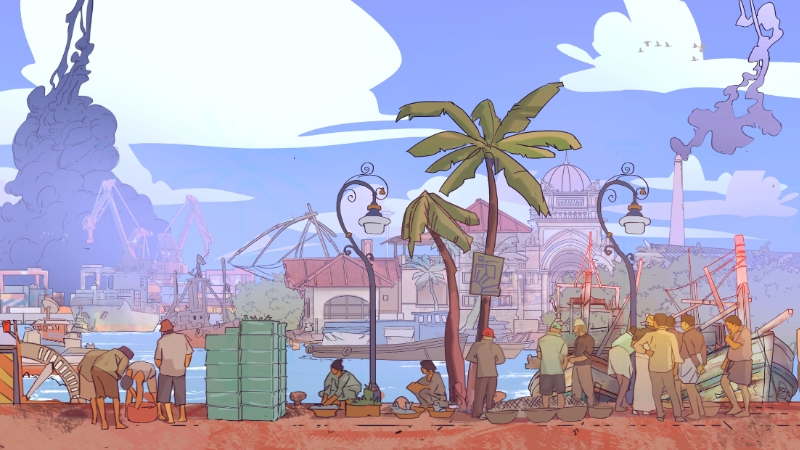
Our setting is Muziris, India: an ancient Keralite city lost to a flood in 1341, whose location is still hotly debated by archaeologists and historians. We are inspired by real-life Kochi and Thiruvananthapuram, and the folklore and traditions of the Malabar region. We are so excited to bring a game set in India to a global gaming audience.
All Will Rise is a mythical eco-crime thriller about taking the powerful to court for the murder of a river. It’s inspired by hit films like Kantaara, and courtroom dramas like Pink, Jai Bhim, Drishyam and Kahaani, and supernatural-fantasy epics like Loka. We’re also inspired by the drama and excitement of anime, and the animist folklore of Dravidian India, and the wild theyyams of the North Malabar. Our gaming influences are Ace Attorney, Disco Elysium and Citizen Sleeper.
The game is also a love letter to the lawyers, activists and ordinary people who fight for our rights and the rights of nature against the corrupt and powerful, in systems which are rigged against them.
Despite being one of the most populous nations on Earth, India is so rarely represented in video games. We want to change that, and bring India’s rich history, traditions and culture to a global gaming audience — the battle for the future starts in Muziris, India, where corporations, corrupt governments and ineffective regulators are challenged by ordinary people who want a better life.
https://www.allwillrise.com/wp-content/uploads/2026/03/YJ_AWR_Migrant_Housing_Crops_07.jpg10801920Chanté Goodmanhttps://www.allwillrise.com/wp-content/uploads/2024/09/transparent.pngChanté Goodman2026-03-07 16:43:182026-03-07 16:45:40All Will Rise – A Game Set in (an Alternate Reality) Kerala, India
playing with the chaos of change By Joost Vervoort – Science and Impact Director
These last two weeks have been so exciting. We’ve finally launched our Kickstarter campaign for All Will Rise, and managed to get 10K support in the first 24 hours, reaching our basic funding goal. Even more encouraging is the response to our public demo. Players everywhere have responded with lots of positive reflections and praise, in a way that shows that they really get what we are trying to do, such as praising the integration of deckbuilding strategy with dialogue, the worldbuilding and writing, and making comparisons to Disco Elysium if it was a more hopeful and change-oriented game.
All Will Rise is here, it’s alive, it’s resonating.
I’ve been in communication about all of this with the good folks over at Fossielvrij, a Dutch activist group who are the original inspiration for the game. They’re very excited that we have reached this point, because they’ve been with us since the beginning.
All the way back in 2021, just when things opened up a bit here and there under COVID, I participated in Fossielvrij’s first meeting to organize a court case against one of the world’s biggest pension funds, ABP, the Dutch civil servants’ pension fund. I’d been inspired by previous cases against Royal Dutch Shell by Milieudefensie and against the Dutch government by Urgenda, seeing the potential in using the court to help pressure big corporations and governments toward a more sustainable future. But this case seemed particularly powerful.
Because whereas companies like Shell are very committed to fossil fuel extraction, their investors are more interested in returns. Shell and others often point to investors like pension funds when asked why they don’t change their policies. ‘People want this, it’s about their pensions.’ So if the pension funds could be swayed, this would have a big impact on the fossil fuel regime.
As soon as the meeting started, with about 40 people live and about 100 people online, I was extremely impressed by the Fossielvrij crew. The meeting was professional, powerful, passionate and clear-headed. I got a strong sense that these people were standing in the heart of the transformation, and could help get important parts of the system to move, even with such a small group (4 people at the time!).
As a game designer, I thought – what can games do to help such an initiative? Phoenix Wright and the Ace Attorney series immediately came to mind, and I proposed the idea of a wild and playful court drama game like that, but about climate and eco-cases. A 16-year-old high school student immediately jumped up and shouted, ‘I LOVE PHOENIX WRIGHT!!’, and that cemented the idea for me. I wrote a blog post about the concept, and it didn’t take us long to assemble a team of talented and experienced game industry people. All Will Rise was becoming a reality.
Shortly after that, Fossielvrij had a shocking and incredible victory – ABP decided to divest all of its 15 billion Euros that were invested in fossil fuels. I was in the online meeting when this was announced, because, next to the game development, I was helping out with the English translation of the case and with international contacts, together with a friend. People couldn’t believe their ears. They were expecting to have to fight for years for this. The drama and unexpected wild joy of this meeting stayed with me as we went into the development of All Will Rise.
Fossielvrij celebrating ABP’s decision to divest their fossil fuel investments in front of the ABP building (I’m the little human standing by the letter r). Photo: Fossielvrij.
Since that time, our game’s setting became more local, focused on a river. This was inspired by the work of lawyer Bénédicte Ficq who said it’s best to work on cases that people find easy to imagine. Our narrative director Meghna Jayanth was enthusiastic about setting our first chapter in India, and we all thought this would offer great possibilities, and this prompted our lead artist Yuvraj Jha to work with us on the project as well. As a result, we ended up speaking with many activists, NGO folks and lawyers in India, giving us many specific insights. We started working together with climate and eco court case expert Loes van Dijk who has a huge network of folks working on cases, including amazing people in India, and we are in fact again in the middle of a series of dialogues. One of the main inspirations has been the winning of legal person rights for the Ganges and Yamuna rivers.
Despite this change in setting, when we played an early version of the demo with Fossielvrij, they regularly burst out laughing at how many things were familiar to them in terms of heated discussions in the team, little frustrations and unexpected challenges. Marianna van der Stel, director of communications for Fossielvrij, emailed me recently that she’d played the newest demo and found it, once again, very relatable to her actual work.
This is so cool to hear. Our producer Niels Monshouwer has a long history in the games industry and one of the things he loves the most about working on All Will Rise is that we draw this kind of inspiration from the exciting, wild realities of real life, instead, as so often happens, only from other games. One of my favorite bits of inspiration was from a lawyer who told us that you have to have a great love and enthusiasm for chaos if you want to be a lawyer in the Indian system. A Dutch laywer we spoke to recently said something similar: the most exciting moments are when you just have to drop everything and run to the courthouse to deal with an emergency. That love of chaos shines through in Kuyili, our protagonist, who sees possibilities everywhere where others just get frustrated. And this is, perhaps, the main thing we hope to instill in players. We are not interested in evangelizing to people about how important taking care of the environment is. Rather, we hope to make people excited about the chaotic, intense, but important work of getting involved with society and actually making a better world. It can be tough, it can be exhausting, but as Fossielvrij and our many connections from around the world show, it can also be joyous, rewarding, and funny as hell.
In the meantime, Fossielvrij and many others around the world keep fighting legal battles for our future. They’ve won a number of court cases more recently against misinformation and greenwashing by corporates. This is happening all around the world. At a global level, climate lawyers are organizing through networks such as ClientEarth to get real collective legal power. We hope that All Will Rise can do its part to support these real-life heroes and show how important their work is.
All Will Rise involves a lot of clashes with people who don’t believe in your strategies, such as Oomanakuttan who has been in the system for decades and is very distrustful of any grandiose claims.
https://www.allwillrise.com/wp-content/uploads/2026/02/image.png714840Chanté Goodmanhttps://www.allwillrise.com/wp-content/uploads/2024/09/transparent.pngChanté Goodman2026-02-28 19:08:162026-02-28 19:22:34The real-life court case that inspired All Will Rise –
All Will Rise has just gone live on Kickstarter! And even greater news, our public demo is currently available to play on Steam! We’re thrilled to be bringing this game to life: a game about taking billionaires to court for destroying the planet. It’s a crime thriller about the murder of a river, with deep deck-building mechanics. It’s a revenge fantasy against the powerful that gets personal, wild, and messy – an experience we believe people need in the current political climate. It’s a game with heart, soul and guts – all things you’ll need to engage while playing!
So why a Kickstarter?
All Will Rise is passionately, unashamedly political. It runs through the very lifeblood of the project. In the current global climate, publishers cautiously and rather rarely take on such a project. Therefore, we’re turning to Kickstarter for funding. We firmly believe the world needs this kind of game right now, a game that wants to raise the spirits and confidence of its players. We hope to inspire other developers to create such a project too.
What do you get out of funding All Will Rise?
Depending on how much you choose to back, you could:
Receive a copy of All Will Rise.
A ‘thank you’ in the credits of All Will Rise.
Early beta access.
Digital soundtrack.
Digital artbook.
Personalized social media shout-out.
Private dev Q&A session.
Design a card in-game.
The team behind All Will Rise, Speculative Agency, is a team of developers who have previously worked on games such as 80 Days, Tricky Towers, Venba, Boyfriend Dungeon, Ultros, Horizon Zero Dawn/Forbidden West, and more. We’ve come together to make a game that responds to a burning world, pouring all their love and rage into it. We deeply appreciate any and all support on All Will Rise!
https://www.allwillrise.com/wp-content/uploads/2026/02/intro_screen_design_clean_cropped-e1771250754927.png6201192Chanté Goodmanhttps://www.allwillrise.com/wp-content/uploads/2024/09/transparent.pngChanté Goodman2026-02-16 14:04:522026-02-16 14:06:06Kickstarter and Game Demo are Live!
How do we bring the vibrant world and gameplay of All Will Rise to living, breathing life? – with music and sound, of course! Ramsey, our composer, and Neha, our sound designer share how they create the heartbeat of Muziris, the ancient city which is the setting for our wild adventure.
Ramsey:
The process starts with finding the right instruments to not only convey the movement on screen but to also rouse the underlying themes of the narrative. It’s about matching the gameplay and visual identity of the game while lifting the story when appropriate.
Collaboration is a key part of that process. Working with game devs early on to agree on a unified vision of what the game should sound like, what its core themes are, and how to amplify them through instrumentation and sound. Throughout, I experiment and prototype different textures and soundscapes, testing how they feel in gameplay until everything becomes a natural extension of the world rather than something layered on top. So I’d say that play testing is important to that process.
Every game is a unique case, so staying flexible is important. Music and sound is highly subjective, so many approaches can work depending on the tone and pacing. Testing the palette of instruments until everything sits naturally within the world of the game is a big part of the process.
Neha:
So my projects are very precise and there’s a clear pipeline for the sound direction. Others, like All Will Rise, give me a lot of freedom. My first step was to play other games that were similar in genre to All Will Rise and carefully listen to their sound design, take notes of unique design choices and look if there were blogs/talks given by the sound designer.
Afterwards, I play through the build and take video captures of everything I need; I prepare an excel sheet to keep track of everything, I come up with a naming convention and get the Wwise (audio middleware software) project ready. Basically, I do a lot of prep work so that once I’m in a creative mode, it can flow as easily as possible. Think of it as cutting up all your vegetables and having them ready for a stir fry! And then starts the most fun yet difficult part: actually creating the sounds! I usually/almost always have a vague idea but, as with most sounds, I only know if it fully works once I get it implemented and hear the ‘feel’ of it in-game.
Ramsey’s music has been a huge inspiration to me. I took some of his stems and used them in my sound effects! You wouldn’t ever hear it, it’s subtle, but I believe it creates a cohesiveness that is felt more than heard.
Ramsey:
Early on, Meghna, the narrative director, introduced me to a few Kerala-specific instruments that inspired the aesthetic, and I really latched on to the chenda and the kombu. The chenda is a percussion based instrument, similar to a Dhol, which is like a large drum that you carry, but is higher pitched and has a more rigid sound to it. The kombu is a unique brass horn. Search for images of them online; their shape curves around into a nearly complete circle and struck me as almost otherworldly. It also produces a powerful trumpet-esque honk that I found especially interesting and effective in punctuating this bleak world of eco-terrorism and climate change. This was an instrument of war during the Sangam period, so that drives the sound of the game as the characters battle for justice against massive conglomerate entities who are literally waging war on the general public with anti-humanist policies. I should admit that I do not have access to a real life kombu, so I definitely take liberties with it, as it has a pretty limited range musically. I extend its range and pitch the sample up and down as needed. This matches the surreal vibe of All Will Rise and further feeds my inspiration for it. The simple nature of the kombu’s melody is helping to cut through the instrumentation of the other things I have going on.
Real life climate change events have also inspired me, such as the California wild fires, hail storms in Saudi Arabia and the powerful cyclones that have hit Texas in recent years. These are natural disasters that make us feel helpless and are ominous signs of impending climate catastrophes. The soundtrack conveys that helplessness aspect to the player–we are at the whims of our environment, but these destructive corporations have held the world captive to their bottom lines and created these catastrophes. The people’s rage comes through in the music. Other inspirations include, but are not limited to, artists such as Dis Fig and Florist, the Hades soundtrack and the Ace Attorney series and even tv shows such as Twin Peaks all lend inspiration to the soundtrack in subtle, underlying ways. We are aiming for something that is profound yet surreal and otherworldly, that can paint a mirror reflection of the darkness of this universe. Not entirely horror leaning but not afraid to dip its toes in it either.
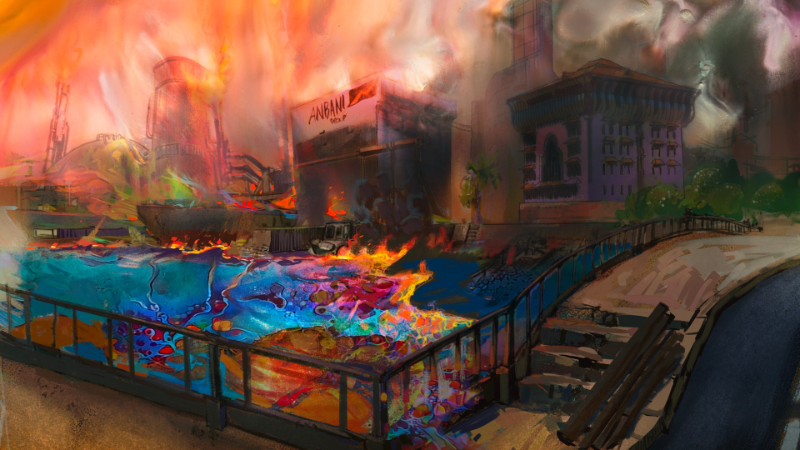
I think in some ways the game wants to hone in on the prevalent sadness and terrifying implicit realities of climate change. There is something profoundly bleak about a river being on fire, an event that, sadly, wouldn’t be too out of place today. Rivers should not be on fire! It is the by-product of human carelessness and environmental misconduct, and that just resonates with me and leaves me feeling despair. That imagery captures the game’s core idea, and represents the relentless assault on our environment and uncomfortable reconciliation between our technological progress and the natural world.
Neha:
When it comes to collaborating, luckily Ramsey is a really good friend of mine, so we already have a basis of trust and honesty. We chat a lot and I request things from him that I need and vice versa. I think because we already know each other, it is easier to give feedback and express ourselves. So in the end, the answer is a little boring but it boils down to collaboration. I have wanted to work with him for years, so this is a dream come true!
Ramsey:
Personally I am a fan of highly collaborative working spaces, and I love getting feedback and targeted direction, so I take into account everyone’s feelings on the matter. What does this clip evoke, what does this song make you feel, does this match the aesthetic we are after, is this piece too brazen and so on. Neha, who is extremely easygoing to work with, will often accommodate my music with thoughtful SFX design by using similar instrumentation to build the sonic language of this universe. When it comes to the music, she gives me her honest first impressions on it and vice versa. It’s a very vibe-based system but it helps in capturing things in the moment and keeps the collaboration experimental.
https://www.allwillrise.com/wp-content/uploads/2026/01/Screenshot-2025-06-09-at-15.40.25-1.png12022284Chanté Goodmanhttps://www.allwillrise.com/wp-content/uploads/2024/09/transparent.pngChanté Goodman2026-01-04 18:44:002026-01-04 19:09:38The Music and Sound of All Will Rise
Building a court case by collecting a deck of cards. The moment we found that combination, we knew All Will Rise was gearing up towards something special, and we plunged into a design space where few had gone before – the much-dreaded conversational card game. Months and years of prototyping and experimentation have passed since then, and we finally have a narrative deckbuilder design we feel confident in. Today, let’s go through some of the basics!
The joy and horror of conversation gameplay is that we’re simulating a deceptively complex activity that we all know very well. Our own lifelong experience of talking to people is an absolute wellspring of inspiration and it’s exhilarating when the game captures how something feels in real life. At the same time, we need the game to be accessible which means we can really only afford to draw on a fraction of that richness. So where to draw the boundary?
Luckily we have a clear focus to ground us: we want to portray not just banter or debate itself, but the joy of making a case. A case is not like any old deck of cards. It’s not just about playing strong cards in general, but hitting the opponent with that one puzzle piece that blows the case wide open, the smoking gun that ties the culprit to the crime in an unbreakable causal chain. Unlike most card games, we needed to pay close attention to how cards connect to each other. That’s where the story web and claim cards come into play.
Claim cards make up the bone structure of All Will Rise, and each one is intimately tied to the game’s plot. By playing one in a conversation, you make the claim printed on the card: “The River Is Dead”, “The World Needs Oil”, “I Speak For The River”. These claims are placed on a hexagonal grid where they connect to surrounding claims to form story chains – “Oil on the River”, and so “The River Burns”, and so “The River Is Dead”. Each claim can connect to multiple causes and consequences, each vying for primacy, forming a network of causes and effects – a story web. As you take turns with your opponent and a sort of shared world view takes shape on the board, the question becomes: whose story wins out? Who controls the narrative?
Giving claims these very specific relationships to each other comes with its own set of design challenges. Decks quickly grow quite large, and nobody wants to draw a full hand of irrelevant claims that don’t connect to anything that’s on the board. That’s why All Will Rise employs a context-sensitive draw pile, meaning that many of the cards in your deck are locked and cannot be drawn to your hand until conditions are right! First of all, claims can only be drawn if they have a narrative connection to another claim on the board. Many cards have other restrictions depending on the characters’ emotional energies, so you will soon find that your playstyle changes with Kuyili’s mood. Savvy players will find ways to manipulate both the opponent’s emotional state and Kuyili’s own to get to the cards they need to play. This draw pile takes full advantage of the game’s digital nature – in a physical card game you’d have to draw and then reshuffle all those locked cards, but in All Will Rise it just happens.
The beauty of the story web is that it’s so versatile – we can make claim cards about practically anything we want Kuyili to be able to talk about. Wherever our sprawling, branching narrative takes us, the claim cards will follow, and no two players’ decks will look alike. We can use card gameplay not just for heated debates and courtroom battles but speeches, conversations with friends, internal monologues and of course interviews with a wide array of witnesses with their own behaviours, weaknesses and unique cards. Like in real conversations, it’s not always about winning. Each relationship in All Will Rise has its own set of goals that change and evolve over time, and the deck you build will determine which of them, and how many of them, you are able to reach, taking you further into the deeper reaches of the web.
Ultimately though, Kuyili will be up against a corporate behemoth with terrifying powers of persuasion, diversion and outright denial, so she will need to prepare a case that can withstand anything, and be ready to improvise when her opponents pull dirty tricks. She prepares her case by talking to people and finding not just new claims, but also evidence that upgrades her existing claims, giving them new abilities and making them less prone to being negated by denial cards. She will also build out an arsenal of rhetoric cards that will alter her play style and, ultimately, which path her story takes. But that will have to be a topic for another time!
https://www.allwillrise.com/wp-content/uploads/2025/07/AWR-Screenshot-Hugo-02-e1752088824550.png8061363Chanté Goodmanhttps://www.allwillrise.com/wp-content/uploads/2024/09/transparent.pngChanté Goodman2025-07-08 18:09:162025-07-09 19:20:52Telling stories with Claim Cards
In All Will Rise, the player will not only choose but also discover Kuyili’s backstory, motivations and personality. So we can’t really answer the question “who is Kuyili”? Only you can, by playing her.
But that doesn’t mean she’s a blank slate. Kuyili is a lawyer who fights for the rights of the earth itself, a bold and ambitious leader of social movements.
Kuyili is playful. A rule-breaker. Capable of looking sideways at the world, and turning obstacles into opportunities. A little deviousness is necessary to taking on the rich, powerful and corrupt.
But most of all, Kuyili is curious about the world. We chose her as our protagonist because we want our players to feel energetic and powerful in a world that encourages us to feel exhausted and despairing.
Kuyili – like all our characters – can draw on different sources of power, or energies: Hearts, Minds and Guts.
The player will choose one of three archetypes to start building their Kuyili, a bit like choosing a character class in an RPG.
The Poet-Hedonist
Passionate, empathetic and committed equally to saving the world and having a good time while she does it. Downsides: extreme people-pleaser, possible anxiety disorder, always hungover. Hosts fantastic dinner parties and breaks hearts like it’s her job.
The Feral Shaman
Connected to nature, the animal world and the animal self. A challenger of the social order and received wisdoms; self-possessed, brazen and just a little bit out-of-control. Loses her passport regularly. Argues with cops for fun, and wins.
The Warrior-Monk
Thinks of herself as cool, thoughtful, friendly and disciplined; comes across as an intense aloof weirdo. Extraordinarily dedicated. Likely to turn into a hermit without the direct intervention of friends and family. Showers three times a day. Likes black metal.
But these archetypes are just a jumping-off point.
The player shapes their own Kuyili — she’s a tumultuous accumulation of hundreds of choices, from the miniscule to the earth-shattering. The brilliant narrative designer Jon Ingold – who I worked with and learned so much from on 80 Days – said that character is not made up of a few big moments, but is an accumulation of small choices over time. He says this about narrative tension too — it’s not the one big choice to kiss someone or not kiss someone, it’s all the moments leading up to it. The shared glance, or the look away. The nervous sip of a drink. Whether to let your knees brush under the table. That final lean-forward before your lips meet. so dizzying it’s impossible to remember which one of you did it first.
This wisdom resonated deeply with me, and has shaped how I’ve approached every character I’ve written. That’s especially true for All Will Rise. We are building a narrative courtroom deck-builder, and our unique systems also allow her character to be dynamic and personalised.
The player unlocks cards through exploring Muziris and making choices. Those cards can represent Claims about the world, or Rhetoric cards which can shape personality and style. Cards can unlock choices or save failures, giving the player characterful and expressive ways to navigate tricky situations and conversational card battles. But beware, whether you charm, intimidate or manipulate, it will have consequences on how characters around you react.
It’s been such an interesting challenge to use our mechanics to try and design a character that feels genuinely responsive and unique, and we have so much more to share in the coming months.
https://www.allwillrise.com/wp-content/uploads/2025/06/Screenshot_2025-06-16_at_17.31.39-e1750152460918.png11641383Chanté Goodmanhttps://www.allwillrise.com/wp-content/uploads/2024/09/transparent.pngChanté Goodman2025-06-17 09:25:512025-07-01 07:25:37Discovering Kuyili Through Play
An important part of working on All Will Rise has been discovering what the game needs to be. How do we make an exciting, resonant, wildly interesting experience that expresses what we most want to express as creators?
When we started conceptualizing All Will Rise, we had this simple idea of a climate court case game with the over-the-top and light tone of the Ace Attorney series. But, as the team formed, several key ideas came together in our search for what the ‘spirit’ of the game would be.
We realized we wanted to avoid the trappings of ‘climate activism’ and ‘serious gaming’. It’s a framing that only speaks to a specific group of people and is not that interesting to us either. Because – well, what is really going on here? The billionaires, oligarchs and corporations are taking everything from us. Our planet, our power, our basic needs and securities. Our futures. This is something we should all be angry about. We need the anger and the sadness as fuel for action. And we want to activate this warrior spirit in as many people as possible – because all of us are getting stomped by the powerful.
But we also wanted the game to be deep, seductive, trippy, and full of mystery. This is what we enjoy ourselves in the games we love most dearly – Disco Elysium, Dark Souls, the Cosmic Wheel Sisterhood, 1000xResist, Signalis, Citizen Sleeper, Hades and more. Each of them is about engaging with a world that just feels resonant and meaningful.
There’s a real potential for games to engage more with the mystery of what it means to be alive. And touching this sense of mystery is also an important source of strength and energy that inspires people to take up the fight against the powerful.
Finally, we wanted the game to be absurd, sharp and weird. Ace Attorney, if it were about ecological collapse and dead gods. Have the game burst with hilarious moments, weird ideas and conversations.
In short, we wanted to make a game that’s a love letter to everything in life that is worth fighting for.
The result is a game that has a strong spiritual element mixed in with social movement strategizing. The river is a god. Spirit vultures circle the headquarters of Resilience Ventures. Our protagonist Kuyili dissolves herself in the ecstasy of dance. We find that there’s a weird mystical link with a person we only saw as an enemy before. Do we exploit it, or perhaps try for an honest connection?
The humour and sense of extra-ness come out in the game’s writing by Meghna and in the lively art by Yuvraj and Enora. There are so many funny moments hidden in all the choices, in the card battles. Lots of card puns, too. The vibes come through in the aliveness of the cards made by Marocha and in the deep game mechanics brought to life by Hugo.
We showcased our most recent demo at the Dutch indie games festival Indigo last week. And it’s the first time all of the above really came together. The new art. New deep card mechanics. The new writing. We played the demo all day with various people, many of whom played for an hour or more. The game just clicked. IGN Benelux came by, and later wrote about All Will Rise as the most striking and promising game of the event: ‘In fifteen minutes I only got a glimpse of the systems. But that glimpse definitely tasted like more. This is an original, thematically daring game that you really should keep an eye on.’ IGN played our biggest battle so far – Kuyili versus the Resilience Ventures VP Rishabh Rai. They are very well matched. Rishabh can be many things to you, and exploring the unexpected possibilities and conversation twists and turns together was riveting.
In the next months, some big announcements will be coming, so keep an eye on our socials… Now that we’ve found the game’s wild, deep, joyous warrior spirit, we are more confident and excited about the future than ever.
https://www.allwillrise.com/wp-content/uploads/2025/06/cardbattle_R_1-e1749217226241.png10811302Chanté Goodmanhttps://www.allwillrise.com/wp-content/uploads/2024/09/transparent.pngChanté Goodman2025-06-05 13:08:302025-06-06 13:40:40Finding the Spirit of All Will Rise
We’re clashing Phoenix Wright, Disco Elysium and narrative deck building with the ecological crisis — to help fund real court cases.
Environmental lawyer Kuyili will be on the tail of corporate exec Rishabh who is embroiled with the power structures of industry and government. Rishabh can be a straight up opponent, a frenemy, or a source of valuable information, depending on how you play the game. Character art by Vijay Krish, background art by Enora Mercier, editing by Marocha Arredondo.
For the last year, we have been working with an amazing team on a game called All Will Rise. All Will Rise is a game about taking big corporates and others responsible for destroying the planet to court. The game is designed to be a much needed infusion of wild joy, curiosity and playfulness in a world where it can be very hard to fight the fight against climate change and ecological crisis. A lively current of electric energy in a time where ecological and climate depression and anxiety are rampant. We hope to inspire laughter alongside a sense of possibility and empowerment in players while taking the maddening political realities of environmental inaction head on. We hope to inspire people to look at what can be done through curious, creative eyes. In terms of game play and tone, it combines the court focus and absurdity of Phoenix Wright with the worldbuilding and narrative exploration of Disco Elysium or Citizen Sleeper. Deckbuilding mechanics a la Slay the Spire have you going out in the world to find clues, evidence, gossip and conversation tactics for challenging narrative encounters and court battles. And this is important: when people buy the game, they know they’re funding real environmental court cases.
From climate action to game design
Let’s talk about where this game came from, and the unusual team behind the project. About three years ago Dutch activist group Fossielvrij (Fossil Free) was at the head of a nation-wide movement to get the pension fund ABP, one of the biggest pension funds in the world, to take its 15 billion euros out of fossil fuel. Building on the successes of court cases against the Dutch Government and Royal Dutch Shell, Fossielvrij was preparing to take ABP to court. At the time, I joined this campaign because I thought it was a brilliant combination of target (a pension fund for civil servants, including myself as an academic) and method, and likely to be impactful. As it turns out the campaign was wildly successful — even before the court case was fully begun, ABP decided to divest all of its fossil fuel investments.
At the first meeting for the preparation of the court case, I thought — how can game design help this cause? What sprang to mind was a game like Phoenix Wright and the Ace Attorney series — a wild, funny and incredibly successful and classic series of games focusing on the court, like an anime Law & Order — but for climate cases. What if a wildly engaging, funny game like this could be made, and if players would know that buying the game would support actual environmental and climate court cases? I remember bringing up this idea, and how a 16 year old in the meeting immediately jumped up and shouted YES! PHOENIX WRIGHT!
Over the next year, an exceptional team gathered around the project. After writing about the idea I was quickly approached by producer Niels Monshouwer — who had made success in indie games and had then gone on to become a producer at Guerrilla Games, working on Sony flagship title Horizon Forbidden West as producer for robots and combat. Niels wanted to bring his experience in indie and AAA games to co-lead the development of this game that aimed to have a big impact on climate action. Niels’s talent and experience as a project leader quickly proved itself — he is steering the ship with a steady hand. I had had enthusiastic and super interesting Twitter conversations with narrative designer Meghna Jayanth, who was interested in games as way to represent and explore diverse worlds and help create deep experiences, and push back against the colonial and capitalist tendencies of the game industry. Meghna is a narrative designer who has led excellent work on games like 80 Days and Sable as well as Horizon Zero Dawn, and most recently, the wildly funny and beautiful Thirsty Suitors. We asked Meghna to join our project, and she enthusiastically said yes. Niels asked talented visual designer Marocha Arredondo, coming off of her work with Guerrilla, to join us, and she brought her experience, fast and flexible working style, and sharp sense for design to the team. Programmer Hugo Bille had led the International Game Developers Association’s Climate Special Interest Group for years — a wonderful community of climate-focused game developers. He had also done excellent work on games like Fe and more recently Ultros. Hugo quickly proved to be essential to the project, developing prototypes and ideas in creative and lightning fast fashion. We invited two excellent artists to the project — Enora Mercier, coming off of experiences with League of Legends and Legends of Runeterra, and Curran Gregory, who had done great character work on Paradise Killer. More recently, Vijay Krish, an artist who had done amazing work on Thirsty Suitors, has joined us for some beautiful and creative character work.
Finally, and I’m so excited about this, we are drawing inspiration for the game’s fashion from the work of my friend sustainable fashion designer Meghna Nayak, whose Kolkata-based company LataSita makes truly beautiful outfits out of old fabrics that could easily turn up in a speculative fiction tv show.
Using Meghna Nayak’s LataSita sustainable clothing designs as inspiration for our characters’ clothing in our speculative version of southern India. Top character sketches by Vijay Krish, design document by Marocha Arredondo.
With this amazing team, and with starting funds provided by the Dutch government’s fund for creative industry, our game, now called All Will Rise, came to life. After we developed our first, more narrative-focused prototype late last summer we gathered a bunch of feedback on it, and the result is a new, fully game play focused prototype. So let’s talk about the game.
Wild joy in dark times
Games that engage with climate change and ecological crisis often only cover part of the possible design space. Either they’re set in a post apocalypse of some kind, or they treat ecological collapse like it’s a technical or management problem. But the reality of environmental action and politics is crazy, ugly, raw, inspiring and frustrating as hell. Activists are fighting for the planet, often with dire or even deadly consequences. There is also lots of love, strength, resilience and community to be found in environmental action, and occasionally, powerful and cathartic moments of hope. This means that the battle for the planet can be a source of inspiration for a fantastic and enthralling game.
With All Will Rise, we draw directly on the experiences of real environmental activists. We have a research team on the project — Kyle Thompson, Lauren McManamon, Mae van Veldhoven and Shreeya Patangay — who have and are conducting research that involves interviews with those at the heart of environmental action and court cases. We are connecting to ClientEarth, the global network of lawyers and legal people working on environmental destruction cases to develop this link between game design and environmental action.
All Will Rise consists of multiple chapters. Each chapter is set in a different part of the world, and focuses on a different case. The world of All Rise is a ‘sideways speculation’ — it is like our world in many ways, but some things are just a bit different, which gives us the change to show how many paths to the future are possible. We start with a concrete, more local case, and then move on to more global concerns such as CO2 emissions.
Our first chapter, The Murdered River, takes place in a sideways speculative version of Kerala state in India. The river of our city Muziris has been polluted to hell. Everyone knows, and nothing is done. But now it’s on fire.
Our player character is Kuyili, a lawyer who has taken up the gauntlet to fight the battle for the environment. Kuyili is a ball of curiosity, intelligence, daring and playful weirdness. She is a major source of the ‘inappropriate joy’ that we want All Will Rise to emanate. She sees the absurdity of our current times, and sees possibilities everywhere to subvert, experiment and mess with the systems around her. You can play Kuyili as more cerebral, more empathetic, or more ruthless and wild, but regardless, she’ll often hear from others that what she is doing should not be allowed. And yet, somehow, she gets things done that no one believes possible. We begin the game with Kuyili and her team coming off of a major victory — the river has been granted legal person rights. A great symbolic victory, but it has not led to any real action. With the river, now a legal person, on fire, Kuyili sees a chance to take those responsible to court for its murder.
But she’s not doing this alone. Inspiring and guiding your team of activists and legal folks is an important part of the game. We have described it as an emotional strategy game in this regard. The emotional energy of your team is a key resource. Climate action is hard, and people have to stay motivated.
Deck-building a better future
The game’s loop starts with a team meeting in which you send your team out on specific missions to gather evidence, gain insights, and new strategies. These are represented as cards that you can add to your deck. Your different team members have different moods, different skills, different motivations. Guiding them well pays off. Matching them with missions that fit them well yields results — but sometimes a strange pairing of skills and assignment can produce unusual outcomes, and cards.
Choosing who should go on what mission can yield unexpected and valuable outcomes — and unusual cards. Character art by Vijay Krish and Curran Gregory; design by Marocha Arredondo.
As Kuyili, you go on your own missions — talking to people, exploring important locations. The core of the game play happens around the encounters you can have with key people — people such as Rishabh, who works for the corporation connected to the region’s fossil fuel industry. Rishabh is eager to ingratiate himself with the corporation’s family, for reasons of love and power. He is involved in local business dealings and politics, and a key target for Kuyili and her team. When you meet Rishabh, you enter a card battle. You alternate playing cards with Rishabh that represent your conversation with him.
As Kuyili, you face off with fossil fuel exec Rishabh in a card battle conversation where each tries to play the other person, using their mind, gut, heart.. and a good dose of weirdness. Character art by Vijay Krish; design by Marocha Arredondo.
Cards can have a range of effects, and they align with different strategies: ‘gut’-cards play on people’s sense of justice and anger, ‘heart’-cards focus on empathy and relationality; ‘mind’-cards focus on logic and evidence; and ‘weird’ cards focus on the weirdness and absurdity. Kuyili and other characters themselves have different scores for each of these stats. Meeting an opponent’s ‘heart’ based card with your own ‘heart’ card indicates that the conversation is flowing well and that you can keep playing. The better the conversational flow, the more chances for you to gain insights or come out on top. But the same goes for your opponent. Each card battle is designed to be able to yield very different results — and give you different cards. It’s possible to lose a card battle but still have a partial win on the ‘weird’ stat if you play the right cards. Rishabh is a really weird guy and you might learn some valuable things about him. You might get some evidence against him that you can use in court later. Or you might get on his good side and agree to meet up again. Maybe over dinner?
You and your team mates go on missions that yield cards: evidence but also strategies and conversational tactics. Design by Marocha Arredondo.
That is the game loop: you organize your team, you and the team find cards in the world, you use those cards to win card battles with challenging and interesting opponents, and the cards you win go into your deck, which represents the case you’re building. All of this culminates in the final card battle of the chapter: the court case itself. We believe this loop of team management, world exploration, and card battles allows for exciting game play, and for a lot of creativity. Our chapters are designed to be rather short, but to allow for many different combined endings. Each card battle also allows for many different strategies. This means that the game can be replayed very easily, and that your choices really matter. You might just find a creative way to win a card battle or manage your team that results in you getting a card that very few other players have seen, further opening up your possibilities.
Build your deck from the cards you get from missions. Design by Marocha Arredondo.
There are some really cool benefits to the deck builder approach to All Will Rise. Representing tactical moves, evidence and insights through cards makes us able to capture the core of climate action in this very strong, easily graspable and flexible format. It allows us to work with climate activists through the language of card development, which is very fun. It allows us to easily expand the game with new card packs and sets — and this can be an amazing tool for fundraising and awareness raising around specific climate campaigns and court cases.
Next steps and funding
With the new playable prototype nearly finished, we have completed our current project funding, and are actively looking for funding for the next phase. We are in conversations with game publishers, but also with public funds and philanthropic organizations interested in supporting the fight for the planet through new and original means.
Our first chapter is The Murdered River, and then All Will Rise will move to other parts of the world. Kuyili and other characters will continue to play a role, while new teams take on new cases everyone is in contact and learning from each other, using Client Earth as a real world example.
Working on All Will Rise has been an absolute blast so far, and the team is just the best. With our second playable prototype almost finished, it is the right time to talk about the game again, which I find to be a real joy as well. Expect many stories about All Will Rise to come out, like this lovely interview I did with games journalist and Rick and Morty writer Heather Anne Campbell who cycled all the way from Amsterdam to Utrecht to talk to me here at home.
If you’d like to talk to us about All Will Rise, now is the time. If you’re interested in discussing funding for the current chapter or the next chapters, get in touch as well!
Environmental collapse and climate change are a real existential challenge for humanity. It can be a heavy and dispiriting struggle. Let’s tap into new sources of energy and joy through play and radical action, and take the risk of being inappropriate in stride.
Get in touch with me via email, Twitter, Bluesky or Linkedin if you’d like to know more about All Will Rise and our next steps!
Dr. Joost Vervoort is an Associate Professor of Transformative Imagination at Utrecht University. His work focuses on connecting games and creative practices, politics and action to create better futures. He leads the NWO Vidi project Anticiplay and is a leading researcher on the Horizon Europe project STRATEGIES which focuses on the transformation of the European game industry. He sings about the global crisis in Terzij de Horde.
https://www.allwillrise.com/wp-content/uploads/2024/09/image-2.png394700Rosa Lewishttps://www.allwillrise.com/wp-content/uploads/2024/09/transparent.pngRosa Lewis2024-02-09 08:04:002025-06-01 15:19:12An Inappropriately Joyous Game About Fighting for the Planet
For the last year or so, a team of researchers and game designers has been working hard on a bold new game concept: All Rise — a game where you take big fossil fuel companies to court, inspired by the Ace Attorney series. Climate games can often be well-meaning, but kind of boring, managerial and technocratic. All Rise aims to break with this trend by combining the wild and playful humor of the Ace Attorney games with the struggles, challenges, heroic actions and emotional rollercoasters of real-world climate politics. The goal is to create a game that is subversive, funny as hell, inspiring and irreverent, while drawing on the experiences of real, successful climate court cases and campaigns. Importantly, the game will be used as a way to raise funds for real climate court cases!
Since this idea was first proposed there have been many great responses to it, and the All Rise team soon found itself lucky enough to count some of the best people in the game industry among its members. This includes Niels Monshouwer, a game producer coming from Guerilla Games’ flagship PlayStation hit Horizon Forbidden West; Meghna Jayanth, narrative designer for brilliant indie games such as Sable and 80 Days as well as for Horizon Zero Dawn; Enora Mercier, an artist with experience with League of Legends and Legends of Runeterra; and Curran ‘Gigalithic’ Gregory, character artist on the singular Paradise Killer. These legends complement a team of researchers in the Anticiplay project, a Dutch research council project focused on games, climate, and societal change.
With much of the team together, we have been looking around for funding to develop a first full demo version of this game. While game ideas and designs were being developed with some seed funding from the Anticiplay project, dedicated funding for the game was, of course, going to be crucial. Producer Niels, with help from the rest of the team, prepared an application to the Stimuleringsfonds Creative Industries Fund — the Dutch government’s fund for creative sector funding.
The Creative Industries Fund NL is the cultural fund for design, architecture, digital culture and any crossovers between them. Read more about it here.
And we are overjoyed to announce that our funding application has been successful! Our concept was judged positively on all criteria. The committee cited appreciation for the ambition to make climate court cases more relatable, and thought the combination of climate court cases and Ace Attorney-style play and art would speak to a wide audience. They also appreciate the team’s composition of experienced game designers, leading researchers, and strong links to activist realities. They expressed a lot of faith in the project and hope the game will inspire broad societal action.
This means that in the next months, we will be working hard on a first version of All Rise. Our goal is to have a short, but complete demo version of the game available which will allow us to mobilize more funding for the full game. From the first full version of the game, we are likely to follow an episode/campaign-like structure, exploring more cases, stories and contexts. We will also be researching the power of the game to inspire as well as to make real-world change through funding actual court cases!
We are so excited to have the opportunity to let this game become a reality. Thank you Stimuleringsfonds Creatieve Industrie!
It wouldn’t be an Anticiplay blog without a Disco Elysium reference — the mega rich light-bending guy has blessed us today. The presence of capital is celebrated.
Anticiplay is an NWO Vidi-funded research project that aims to establish a new design paradigm for the gaming sector in collaboration with CreaTures EU. You can find our mission statement here! In short: we’re all about Games For Better Futures and Futures for Better Games. Follow us @anticiplay on Twitter, and feel free to engage us with any questions, games that you think are inspiring, and anything else!
We may request cookies to be set on your device. We use cookies to let us know when you visit our websites, how you interact with us, to enrich your user experience, and to customize your relationship with our website.
Click on the different category headings to find out more. You can also change some of your preferences. Note that blocking some types of cookies may impact your experience on our websites and the services we are able to offer.
Essential Website Cookies
These cookies are strictly necessary to provide you with services available through our website and to use some of its features.
Because these cookies are strictly necessary to deliver the website, refusing them will have impact how our site functions. You always can block or delete cookies by changing your browser settings and force blocking all cookies on this website. But this will always prompt you to accept/refuse cookies when revisiting our site.
We fully respect if you want to refuse cookies but to avoid asking you again and again kindly allow us to store a cookie for that. You are free to opt out any time or opt in for other cookies to get a better experience. If you refuse cookies we will remove all set cookies in our domain.
We provide you with a list of stored cookies on your computer in our domain so you can check what we stored. Due to security reasons we are not able to show or modify cookies from other domains. You can check these in your browser security settings.
Google Analytics Cookies
These cookies collect information that is used either in aggregate form to help us understand how our website is being used or how effective our marketing campaigns are, or to help us customize our website and application for you in order to enhance your experience.
If you do not want that we track your visit to our site you can disable tracking in your browser here:
Other external services
We also use different external services like Google Webfonts, Google Maps, and external Video providers. Since these providers may collect personal data like your IP address we allow you to block them here. Please be aware that this might heavily reduce the functionality and appearance of our site. Changes will take effect once you reload the page.
Google Webfont Settings:
Google Map Settings:
Google reCaptcha Settings:
Vimeo and Youtube video embeds:
Other cookies
The following cookies are also needed - You can choose if you want to allow them:
Privacy Policy
You can read about our cookies and privacy settings in detail on our Privacy Policy Page.
To provide the best experiences, we use technologies like cookies to store and/or access device information. Consenting to these technologies will allow us to process data such as browsing behavior or unique IDs on this site. Not consenting or withdrawing consent, may adversely affect certain features and functions.
Functional
Always active
The technical storage or access is strictly necessary for the legitimate purpose of enabling the use of a specific service explicitly requested by the subscriber or user, or for the sole purpose of carrying out the transmission of a communication over an electronic communications network.
Preferences
The technical storage or access is necessary for the legitimate purpose of storing preferences that are not requested by the subscriber or user.
Statistics
The technical storage or access that is used exclusively for statistical purposes.The technical storage or access that is used exclusively for anonymous statistical purposes. Without a subpoena, voluntary compliance on the part of your Internet Service Provider, or additional records from a third party, information stored or retrieved for this purpose alone cannot usually be used to identify you.
Marketing
The technical storage or access is required to create user profiles to send advertising, or to track the user on a website or across several websites for similar marketing purposes.